 Physiotherapy
 Nursing
 Medical Equipment
 Trained Attendants
 Lab Tests
 Elder Care
 Doctor Consultation
 Mother & Baby Care
 Diabetes Care
 Critical Care
 Covid Care
 Vaccination
 Counselling
 Nutrition & Diet Consultation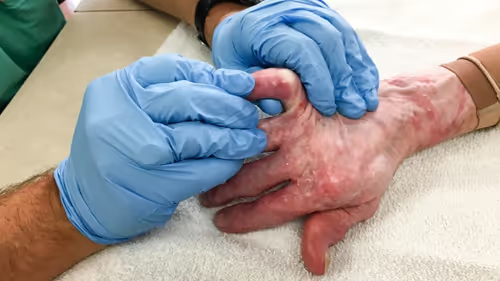
Hi,
I am a premium package member ( patient name: Nikhat Begum)
I just wanted to thank the customer support team. Especially Partha Sarthy, he has been extremely helpful and prompt in solving my concerns. I am very happy about how he went out of his way to make things happen in a timely manner and followed up post-resolution.
- 4.8On Google
- Background-verified professionals
Expert Physiotherapy at Home
Certified physiotherapists visit you at home to provide focused, one-on-one care tailored to your needs. With no travel or waiting rooms, recovery happens in a setting that is comfortable, familiar, and built around your convenience.
Personalised Recovery Programmes
Every treatment plan is designed to suit your condition, goals, and pace. Our physiotherapists follow structured, evolving protocols to ensure consistent progress, with each session aligned to deliver meaningful results.
Trusted Physiotherapists. Real Results.
Our team comprises experienced, background-verified physiotherapists trusted by thousands of families. With a strong focus on safety, reliability, and clinical outcomes, we make recovery at home both effective and reassuring
Patient Testimonials
Real experiences from the families we care for
To whom this letter of recommendation may concern.
Dear Sir,
I would like to share our very positive feedback concerning your business partner Vinay Venugopal.
He has been nothing but diligent and efficient in organising PCR tests for the whole family on behalf of Portea. And this several times being particularly proactive in paving the way through the registration and payment processes of the company, smoothing the way out for us right form the start until we received our results.
Kindly take this recommendation as a priority as Vinay Venugopal is certainly an added value to any company he would offer his services to.
Not to mention being able to communicate in English with him really took the stress off the whole medical process, which can certainly not be said for other laboratory partners.
This is one of the reasons we will carry on giving our business to Portea.
Best regards,
Johanna SALVADO and Family
The physiotherapist behaved professionally and the service was good. Call center executives were also good at addressing my concerns Thank you Santosh You have honestly done your job here. I got the account into my account
Hello Mr. Parthasarathi,
I am very much delighted to thank you for your immediate response to sort out the problem and difficulty I was facing to get the Blood test reports due to some problem. First the reports sent to me were incomplete.
Then you come into this picture and you are able to listen carefully to the problems I was facing from morning.
With your personal efforts I was able to get the full and Complete Email blood reports.
Thank you for your timely help.
Best wishes.”I, Raghav Pant got tested positive for COVID 19 on the 19th of April. Post that I was admitted to the hospital for continuous dip in my saturation / oxygen levels. I was admitted for 9-10 days where I underwent treatment.
During the course of my treatment in the hospital I was introduced to Dr. Neeraj (Physiotherapist), with whom I had few physiotherapy sessions in the hospital. Dr. Neeraj is a highly professional doctor, he not only understood the need of the hour i.e. my treatment but also counselled and motivated me to get better , something I believe was more important than anything else at that time.
Through Portea I was fortunate enough to get Dr. Neeraj as my physiotherapist once I got discharged from the hospital. Both my mother and myself took 5 days of session with the Doctor and after 5 days our saturation level peaked to 97/98, all thanks to the dedication , motivation provided by Dr. Neeraj to my mother and myself who have now completely recovered.
I would like to take this opportunity to thank Portea and Dr. Neeraj for helping us in our road to recovery post COVID 19.
Thank you
Raghav PantDear Portea,
My dad really likes the physiotherapist. It’s made a big difference to his walk and well-being already.
Many thanks for this.Kavitha Buggana
I got my bloodwork done at Portea. The whole process was smooth and professional. My appointment was booked for 12 noon and the person came by 11:55am. They sanitized themselves and all the equipment was new and sealed. The blood draw was painless and fast. The whole process lasted just 5 mins. The next morning I received all my bloodwork via email. This is the most convenient and high quality experience of blood diagnostics I’ve had. Highly recommend to anybody and everybody! I will never visit a clinic for this again.
I had a very good experience with (Magimai rani) who visited our house and helped us.Thanks..!
Rakesh was excellent with the service and he was able to diagnose the problem very soon and gave the right treatment.
I was feeling better just after one session. Highly recommend him!Dr. Ritu was very helpful for my recovery post surgery. She has done a lot of effort to make me feel relaxed as well as energetic at the same time. After her session I am back to my job now. Thanks.
Portea Physiotherapists for Home Visits
Meet some of our experienced and dedicated healthcare professionals
![Hirak Subhra Chatterjee - Physiotherapist at Portea Medical]()
Hirak Subhra Chatterjee
Physiotherapist
18+ yrs experience
- Orthopedic
- Musculoskeletal
- Sports rehab
- +6 more
![V Saravanakumar - Physiotherapist at Portea Medical]()
V Saravanakumar
Physiotherapist
15+ yrs experience
- Adult Neurology
![Sabyasachi Ghosh - Physiotherapist at Portea Medical]()
Sabyasachi Ghosh
Physiotherapist
BPT · MPT·12+ yrs experience
- Orthopedic
- Musculoskeletal
- Exercise Physiology
- +2 more
![Prakash Vadivel - Physiotherapist at Portea Medical]()
Prakash Vadivel
Physiotherapist
12+ yrs experience
- Adult Neurology
![Nidhi Bhalla - Physiotherapist at Portea Medical]()
Nidhi Bhalla
Physiotherapist
BPT·10+ yrs experience
- Adult Neurology
- Paediatric Neurology
![Arnab Das - Physiotherapist at Portea Medical]()
Arnab Das
Physiotherapist
10+ yrs experience
- Orthopedic
- Musculoskeletal
- Adult Neurology


Your journey to a pain-free future starts here
Personalised Physiotherapy at Home
Flat 10% Off on booking packages
Book Now*T&C apply


How to Recognize the Different Recovery Phases in Burn Injury Treatment?
Post-burn recovery occurs in different stages, starting with the acute phase, where pain and infection control are prioritized. The intermediate phase focuses on wound healing and early mobilization, while the long-term rehabilitation phase aims at restoring function, minimizing scarring, and improving strength and flexibility. A structured rehabilitation plan is essential to prevent complications and enhance overall recovery.
What Are the Key Causes of Complications During Post-Burn Rehabilitation?
Burn injuries can cause severe damage to the skin, muscles, and joints, leading to complications such as:
- Contractures: Tightening of the skin and muscles, limiting movement.
- Hypertrophic Scarring: Excessive scar tissue formation causing stiffness.
- Muscle Weakness: Prolonged immobility leading to muscle atrophy.
- Psychosocial Challenges: Anxiety, depression, and body image concerns affecting overall well-being.
What Risk Factors Impact Recovery After a Burn Injury?
Some factors increase the likelihood of post-burn complications, including:
- Severe burns covering large areas of the body.
- Delayed medical intervention or improper wound care.
- Prolonged immobility leading to stiffness and weakness.
- Pre-existing health conditions that slow the healing process.
How Can Preventive Physiotherapy Help Avoid Complications After a Burn Injury?
To promote optimal recovery, patients should follow these rehabilitation strategies:
- Early Mobilization: Encouraging movement to prevent stiffness.
- Scar Management: Use of compression garments and massage therapy to reduce excessive scarring.
- Stretching and Strengthening Exercises: Preventing contractures and rebuilding muscle strength.
- Pain Management: Medications, hydrotherapy, and relaxation techniques to alleviate discomfort.
- Psychological Support: Counseling and therapy to address emotional distress.
What Are the Diagnosis and Rehabilitation Approaches After Burn Injuries?
A multidisciplinary approach is essential for post-burn rehabilitation, including:
- Physical Therapy: Exercises to improve range of motion and mobility.
- Occupational Therapy: Assistance with daily activities and adaptive techniques.
- Scar Therapy: Use of silicone sheets, laser therapy, and pressure garments.
- Hydrotherapy: Water-based exercises to ease stiffness and improve movement.
- Assistive Devices: Braces and splints to support healing and function.
Why Is Physiotherapy Important in the Burn Recovery Process?
Physiotherapy plays a significant role in post-burn rehabilitation by preventing contractures, reducing stiffness, and improving overall mobility. Physiotherapists develop customized exercise plans to restore function, promote independence, and enhance overall well-being. Techniques such as manual therapy, stretching exercises, and functional training help patients regain movement and confidence in their abilities.
How Does Portea’s At-Home Physiotherapy Support Burn Rehabilitation?
At Portea, we provide specialized home-based physiotherapy services for burn survivors, focusing on scar management, pain relief, and functional recovery. Our expert physiotherapists design personalized treatment plans that help patients regain mobility, reduce stiffness, and enhance their quality of life.
Beyond post-burn rehabilitation, we offer a wide range of physiotherapy services, including neuro-rehabilitation, post-surgical recovery, orthopedic care, elderly physiotherapy, and pain management. With our dedicated team, we ensure that every patient receives professional and personalized care in the comfort of their home.
FAQs
1. Why is early physiotherapy important after a burn injury?
Early physiotherapy helps prevent joint stiffness and muscle shortening, reduces scarring, and promotes faster recovery by encouraging movement and restoring functional mobility post-burn.
2. What exercises are recommended during post-burn rehab?
Post-burn rehab includes gentle range-of-motion exercises, stretching to prevent contractures, strengthening routines, and functional training to restore daily activity performance.
3. Can home physiotherapy manage burn scars effectively?
Yes, home physiotherapy includes scar massage, pressure garment education, and mobility exercises that help minimize hypertrophic scarring and improve tissue flexibility and appearance.
4. How long does post-burn rehabilitation usually take?
Rehabilitation duration depends on burn severity and location. It may range from weeks to several months, with consistent physiotherapy required to maintain mobility and function.
5. What psychological benefits does rehab provide to burn survivors?
Rehabilitation builds physical confidence, reduces dependency, and supports emotional recovery. It helps manage anxiety and depression, boosting the patient’s self-image and social reintegration
Portea Services
Elder Care
Trained Attendant
Physiotherapy
Critical Care
Medical Equipment
Nursing
Doctor Consultation
Mother & Baby Care
Lab Tests
Speciality Pharma
- > Our Team> Blogs> Doctor Speak> Press & Media> Investor Relations> Annual Return> Careers> Partner With Us> Contact Us> FAQs> Testimonials
- > Physiotherapy> Doctor Consultations> Nursing> Medical Equipment> Trained Attendants> Lab Tests> Counselling
- > Physiotherapy for Back Pain> Physiotherapy for sports> Eldercare for Parents> Injections and IVs> Cholesterol tests> Refer a friend
For Bookings and Service queries:
Ph: 1800 121 2323 Email: bookings@portea.comFor Customer Support & Feedback:
Ph: 1800 121 2323 Email:customersupport@portea.com![Facebook]()
![Twitter]()
![Youtube]()
![Instagram]()
![LinkedIn]()


*I agree to be contacted by Portea over phone and email. I do not have any objection to receiving emails, messages (SMS or any other mode) and calls from Portea. This consent shall supersede any preferences set through Do Not Disturb (DND Register)/ National Customer Preference Register (NCPR).
Privacy Policy | Terms and Conditions | Patient Rights & Responsibilities© 2026 Healthvista India Private Limited. All rights reserved.
Portea™ is a brand of Healthvista India Private Limited · CIN: U85300KA2013PTC069291